











The Short Answer Before You Order
Order a grazing table when the display has to feed the room. Order a charcuterie board when it only has to start the night.
Both use the same family of ingredients. Cured meats, cheeses, fruit, nuts, bread. What changes is the size of the display, how much variety sits on it, and what guests are meant to do with it.
This post compares the two formats on scale, variety and guest use so you can pick one with confidence. If you already know you want the larger version, our grazing table catering page walks through how one gets built.
What Is the Difference Between a Grazing Table and a Charcuterie Board?
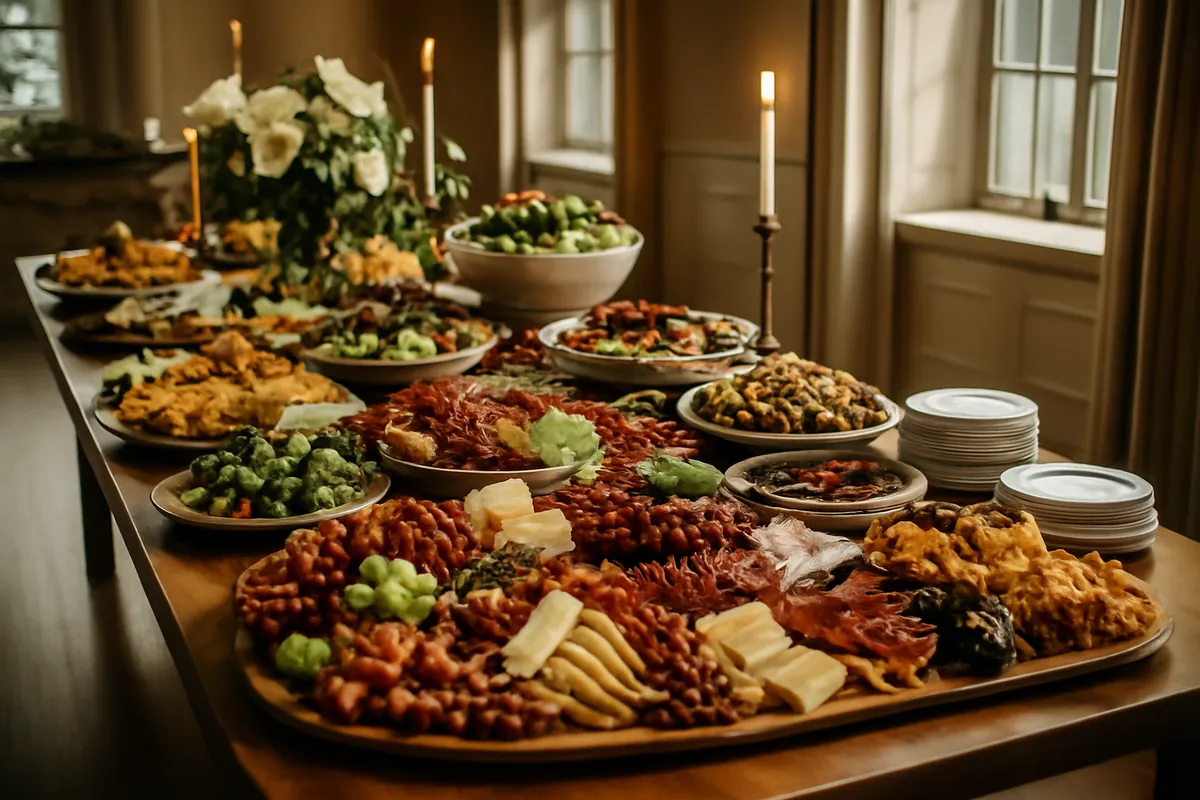
A charcuterie board is one platter. A grazing table is a whole table of food, and a charcuterie board can sit inside it as one piece of the spread.
That is the cleanest way to think about it. One is a dish. The other is a display the room gathers around.
What sits on a charcuterie board
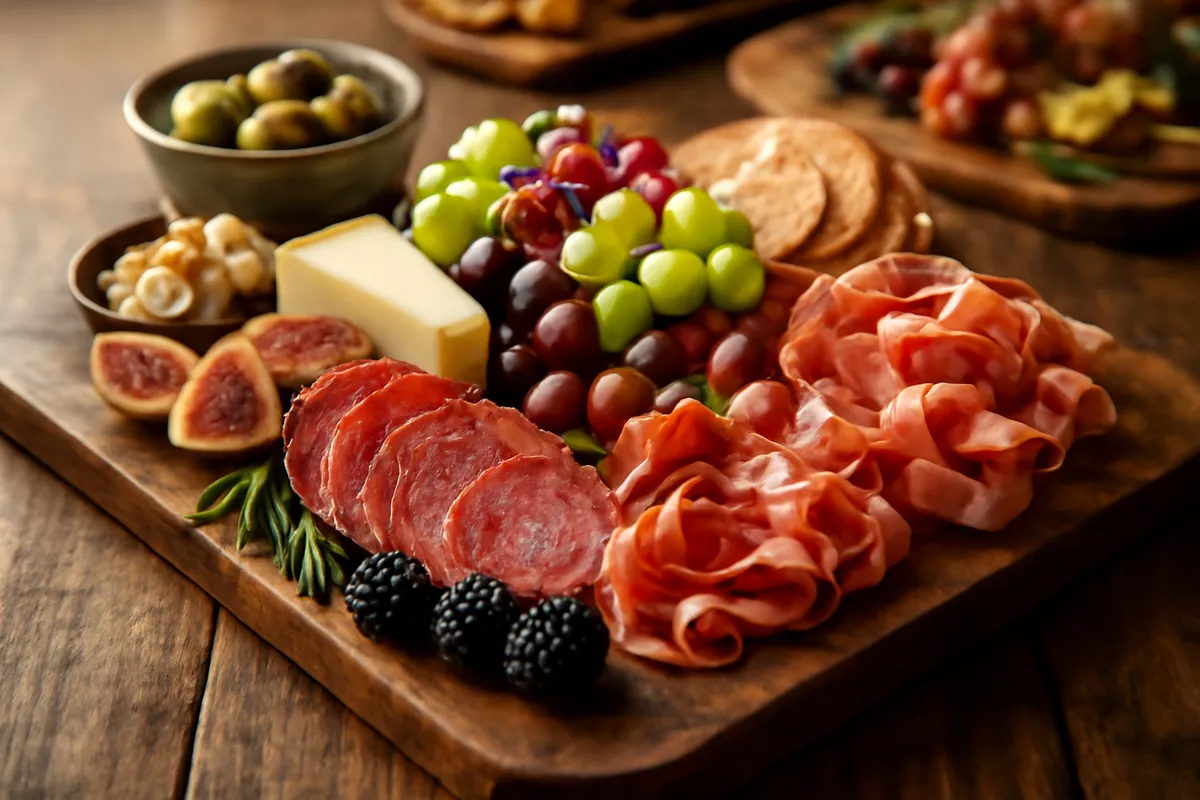
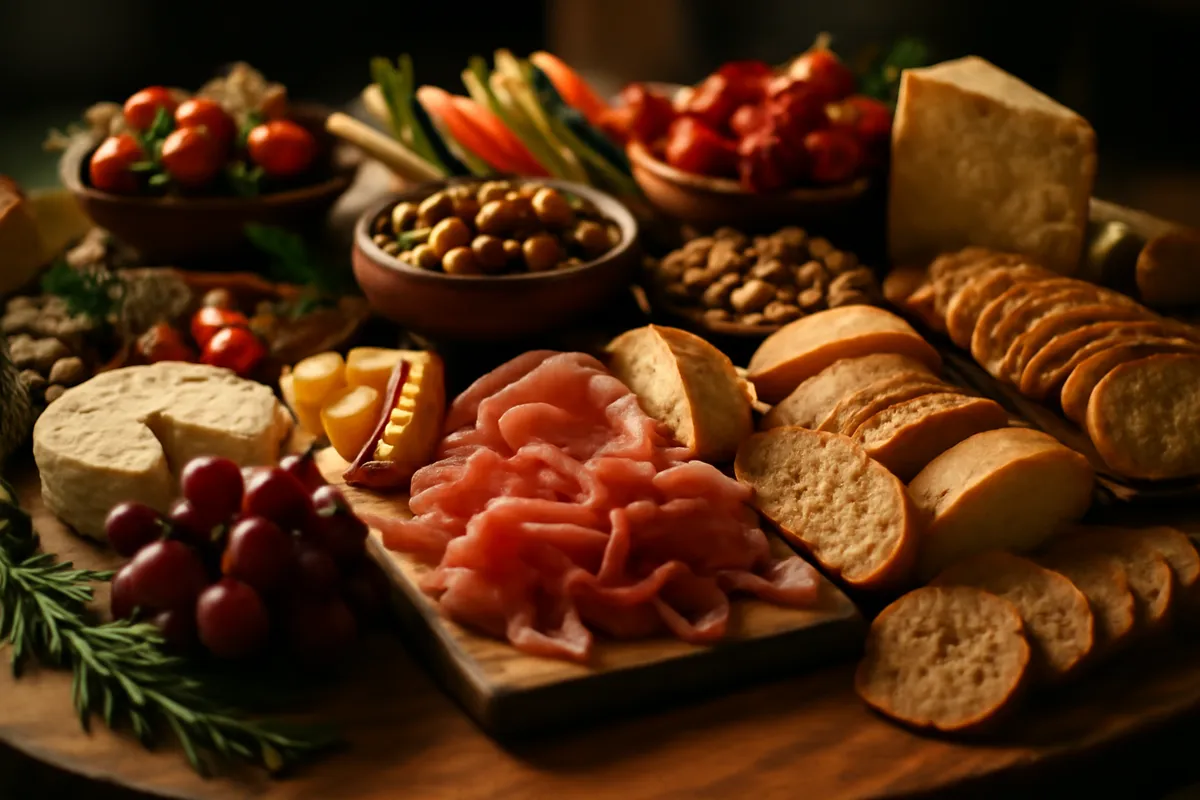
A board is built around cured meats and cheeses. Prosciutto, salami and sopressata next to an aged cheddar, a soft brie and a bold blue. Around them go a few pairings: grapes, figs, olives, nuts, honey, mustard, crackers and sliced bread.
The list is short on purpose. A board is meant to read clearly from a few feet away and get eaten in one pass.
What sits on a grazing table
A grazing table starts with the same meats and cheeses, then keeps going. Fresh and dried fruit, vegetable platters, house-made dips, hummus, crostini, artisan breads, seasonal produce and sweets all go on. Edible flowers and fresh herbs fill the gaps so there is no bare surface.
The point is abundance. Guests should see more than they can eat and still find something new on a second trip.
The two names get used interchangeably online, which is where the confusion starts. In catering they are priced, staffed and set up differently, so the choice matters.
How Many Guests Can Each One Feed?
A single board is an appetizer for a small group. A grazing table is sized to the guest count and can carry a crowd.
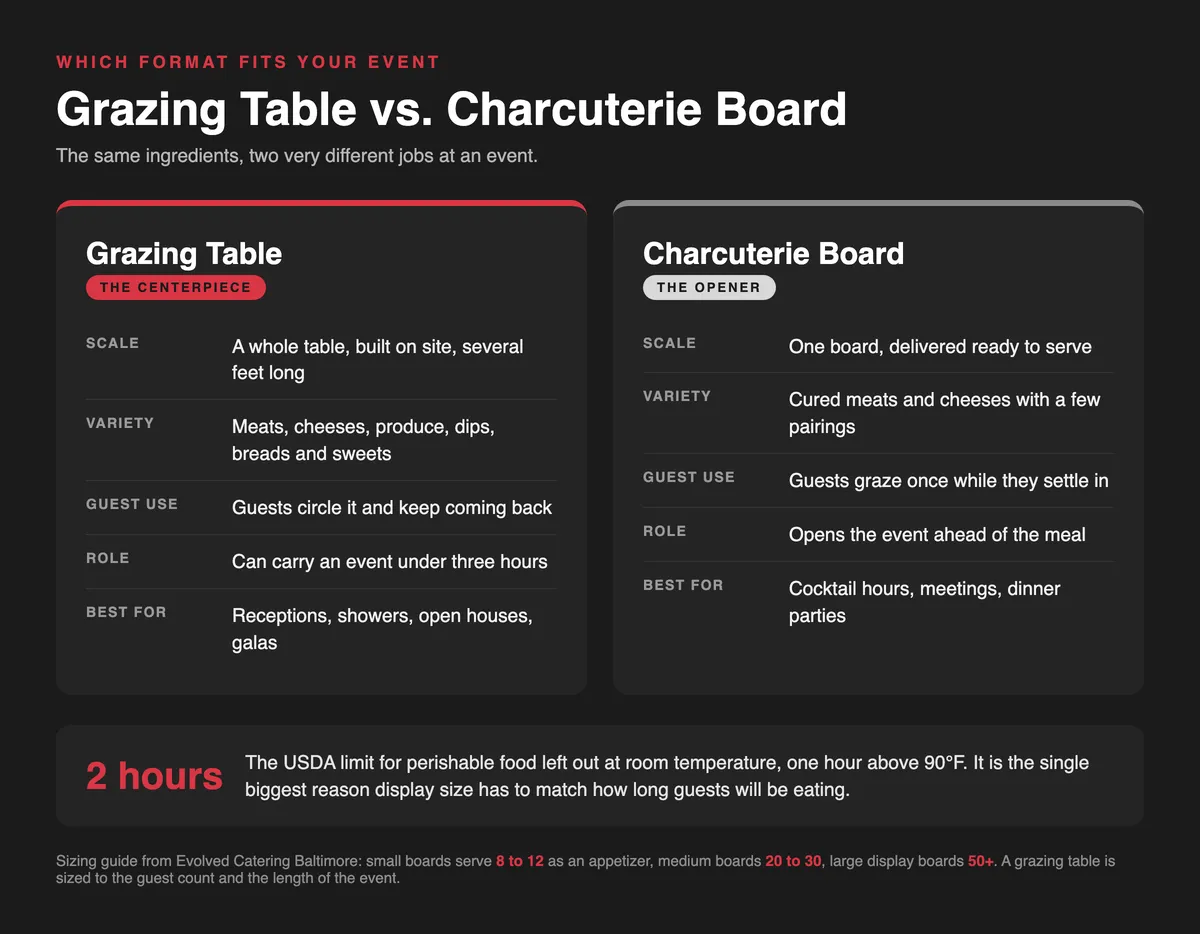
Our own boards give a useful scale. A small board works as an appetizer for 8 to 12 guests. A medium board covers 20 to 30. A large display board handles 50 or more. Past that, you are no longer talking about a board. You are talking about a table.
Guest counts are why this matters. The Knot reports an average of 116 guests at a wedding, and a room that size will walk past a single board in minutes. A grazing table is built to hold that many people and keep holding them.
Length is the other lever. A grazing table gets longer as the guest list grows, and the spread gets wider so people are not all reaching for the same bowl.
There is also a time limit. A well-built grazing table can serve as the main food offering at an event under three hours. Go longer than that and it needs a second station or a light buffet beside it, or guests will outpace the table.
How Do the Two Formats Play Out at a Real Event?
They arrive differently, and that is the part most people do not plan for.
A charcuterie board is delivered finished. Chef Zack Trabbold builds it the morning of the event and it arrives ready to serve, so nothing is asked of your venue or your team. It goes on a table and guests start eating.
A grazing table is built on site. Our crew brings the ingredients, the wooden boards, the slate tiles and the props, and the venue supplies the table surface. Setup runs about an hour before doors open, and every item is placed by hand. During the event we can come back and refresh the table so it still looks full at the end.
We have run both across Baltimore. Grazing tables at weddings in Mount Vernon, corporate events in Inner Harbor and private parties in Canton. Boards delivered to offices in Towson, meeting spaces in Hampden and engagement parties in Fells Point. The pattern is consistent: the table becomes the room’s centerpiece, and the board quietly does its job in a corner.
Time out of refrigeration shapes both. The USDA warns that perishable food should not sit between 40 and 140 degrees for more than two hours, and only one hour once it is above 90 degrees. That is why an outdoor summer event in Baltimore gets a different build than an indoor winter one, and why a long reception gets refreshed instead of left to sit.
A Maryland detail worth knowing: we build local boards with crab dip and Old Bay accents. On a grazing table that becomes a full station. On a single board it is one feature among a few.
How Do You Choose Between Them?
Start with one question: is this display the food, or is it the warm-up?
Choose a grazing table when
The display is meant to be the first thing guests see. You have 50 or more people. The event runs two to three hours with no seated meal. You want photos of it. Or you want a food item that doubles as decor, which saves you a separate centerpiece budget.
Choose a charcuterie board when
A real meal is coming later. The group is small enough to clear one platter. The venue has no spare table to give up. Or you need something delivered and ready with no setup window, which is the usual case for an office lunch or a client meeting.
Think about where guests will stand, too. If they will be on their feet the whole time, the display competes with the room for space, and our guide to how much seating a cocktail reception needs covers how to lay that out.
If a seated dinner follows, a board is usually the better opener, and passed versus stationary appetizers is worth reading before you lock the cocktail hour. For weddings, confirm the headcount first, because collecting meal choices with your RSVPs is what tells you how big the display really needs to be.
You can also run both. A grazing table during cocktail hour and smaller boards on the bar or the lounge tables is a common setup at larger receptions, and it keeps lines from forming in one spot.
Frequently Asked Questions
Is a grazing table more expensive than a charcuterie board?
A grazing table costs more in total because it is much bigger and takes staff time to build on site. Per guest it often lands close to a board, since the table feeds far more people. The honest comparison is cost per guest, not the sticker price.
Can a grazing table replace a full meal?
For an event under three hours, yes. A well-built grazing table can be the main food offering. For longer events we pair it with another station or a light buffet so guests stay satisfied through the back half.
How far in advance should I order one in Baltimore?
One week is the minimum for a board. For a large display or an event over 100 guests in Baltimore, give us two weeks so we can source the best ingredients. Rush orders are sometimes possible, so it is worth calling at 443-272-4386 either way.
Build the Right Display for Your Baltimore Event
Tell us your guest count and how long your event runs, and we will tell you which format fits and what it costs.
Evolved Catering Baltimore builds grazing tables and charcuterie boards for weddings, corporate events and private parties across Baltimore and the surrounding region.