










The Short Answer Is Supervision, Not the Menu
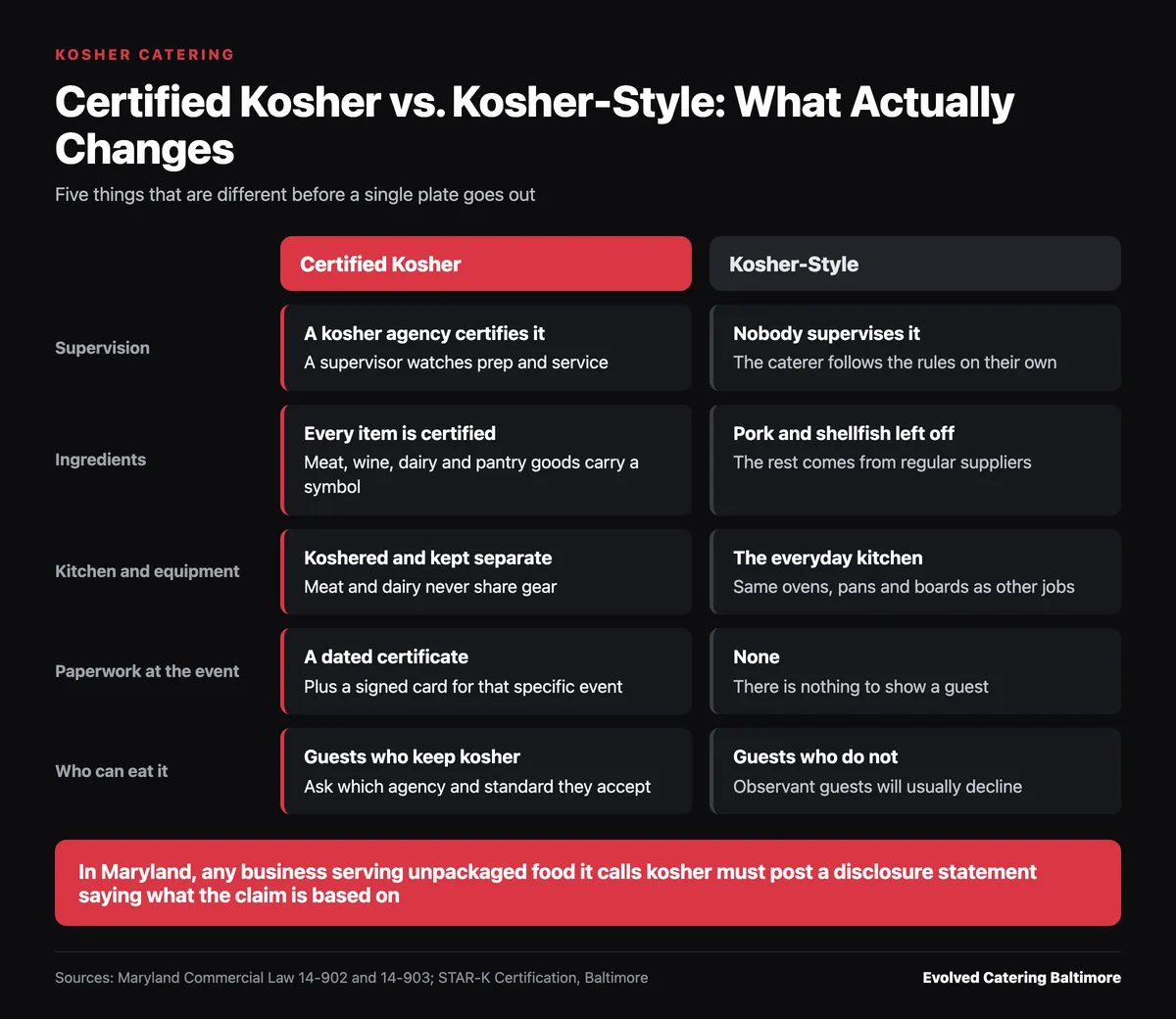
Certified kosher catering is watched and approved by a kosher agency. Kosher-style catering is a menu choice with no agency behind it.
The two can look the same on the table. What changes is who checked the kitchen, the ingredients and the people cooking.
Below is what each term covers, what to ask before you book, and how to check a claim in Maryland. For the service itself, see our kosher catering in Baltimore page.

What Does Certified Kosher Catering Actually Mean?
Certified kosher means an outside kosher agency approves the caterer and watches the work. The caterer does not grant it to themselves.
The agency starts with the shopping list. Meat, poultry, wine, dairy and pantry goods all have to carry a kosher symbol from an agency the host accepts. A swap at the last minute is not allowed without a check.
The Kitchen Counts as Much as the Food
Equipment is koshered before the job starts. Meat and dairy get their own pans, boards, knives and serving gear, and the two sets never cross. Ovens and work surfaces are prepared the same way.
Someone Watches the Whole Service
A trained supervisor, called a mashgiach, is on site while the food is made and served. They check deliveries, watch the prep and stay through service. On larger jobs there is more than one.
The event gets paperwork of its own. Agencies give the caterer a dated card for your date, signed by the supervisor. It goes where guests can see it. The caterer also holds a certificate with an expiry date on it.
Certified Is Not One Single Standard
Agencies run to different levels, and the words show up on menus. Glatt kosher is a stricter standard for meat. Cholov yisroel is a stricter standard for dairy. Some families accept one agency and not another, so the name on the certificate matters as much as the word kosher.
Kosher-style catering skips every one of those steps.

What Is Kosher-Style Catering, and What Changes?
Kosher-style is a cooking style, not a certification. It describes what is on the menu, not who inspected it.
A kosher-style menu usually leaves off pork and shellfish and keeps meat and dairy apart on the plate. The dishes are often familiar Jewish favorites, such as brisket, latkes or matzo ball soup.
What does not change is the back of house. The kitchen, the suppliers and the staff are the caterer’s usual ones. Nobody from an agency has seen the job.
Certification is a formal system with a long paper trail. STAR-K Certification alone covers more than 3,100 locations in 48 states and 63 countries. It is one of over 1,400 kosher agencies worldwide. A kosher-style menu carries none of those marks.
That is why the two prices are so far apart, and why the two are not swaps for each other. One is a menu. The other is a chain of checks.
How Do Baltimore Hosts Check a Kosher Claim?
In Maryland you can check the claim in writing before you book. You do not need to be an expert to do it.
Any business that sells or serves unpackaged food it calls kosher has to post a disclosure statement on the premises. It has to be in plain language. It has to say what the claim is based on, including how the food is prepared and handled. Ask to see it.
Advertising has its own rule. A business cannot advertise food or a place as kosher supervised unless the ad names the rabbi or agency supervising it. If a caterer says supervised and will not name who, that is your answer.
Baltimore is a good city to ask the question in. STAR-K was chartered in 1947 as the Vaad Hakashrus of Baltimore. It still runs out of the city today, and you can look up certified establishments on its own site.
How We Handle It
Our Baltimore kitchen opened on South Newkirk Street in Highlandtown in February 2026. For kosher events we work with local kosher certification authorities on the ingredients and the preparation. We ask for about two weeks of notice so the sourcing and the supervision are lined up before the date.
One more step is worth taking. Guests keep different standards, and an agency one family accepts is not always the one another family accepts. Ask the people you are feeding which agency they go by, then book to that answer.
Which One Fits Your Event?
Choose certified kosher when guests who keep kosher have to be able to eat. Choose kosher-style when nobody at the table needs supervision and you want the flavors.
Start with a count, not a feeling. If the rabbi, the grandparents or a handful of guests keep kosher, certified is the only option that works for them. A kosher-style plate will sit untouched.
Budget is the other half of the call, and the gap is real. We break the numbers down in how much kosher catering costs. Read it before you pick a lane.
Format matters too. A supervised event has tighter rules about what can be displayed and how long food stays out. That shapes a choice like a grazing table or a charcuterie board. It also shapes how you plan seating at a cocktail reception.
Check the venue early too. A supervised event often needs the venue kitchen koshered before the job, and some venues will not allow it. Ask the venue before you sign anything, not after.
Whatever you pick, put it in the contract in plain words. Write certified kosher under the named agency, or write kosher-style, and have both sides sign the same sentence.
Then tell your guests which one it is on the invitation or in the event email. People who keep kosher plan around the answer. They would rather know in advance than find out at the door.
Frequently Asked Questions
Is kosher-style food actually kosher?
No. Kosher-style describes a menu that avoids pork and shellfish and keeps meat and dairy apart. It is cooked in a regular kitchen with regular suppliers, and no agency certifies it.
Can guests who keep kosher eat kosher-style catering?
Usually not. Guests who keep kosher are looking for supervision and certified ingredients, and kosher-style has neither. If those guests matter to you, book a certified kosher caterer instead.
What should I ask a Baltimore caterer to confirm kosher supervision?
Ask three things. Which agency certifies the event. Whether a supervisor will be on site for the whole service. And to see the disclosure statement Maryland requires any Baltimore business serving unpackaged kosher food to post. A certified caterer answers all three without hesitating.
Planning a Kosher Event in Baltimore?
Tell us who is coming and what they keep. We will build the menu and the plan around it for your Baltimore event, and walk you through the options.