











Your Contract and Food Safety Decide What Happens
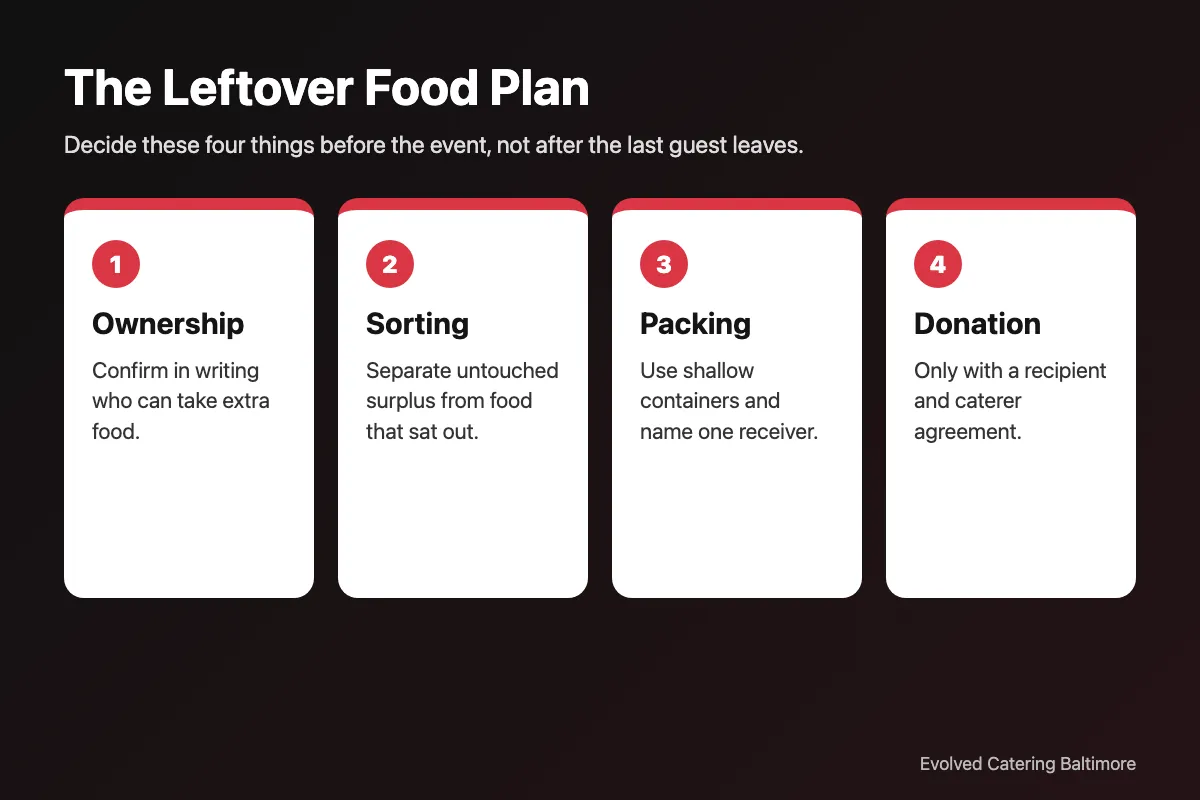
Leftover food goes where your catering agreement says, as long as it has been held safely and someone is ready to take it. Evolved Catering Baltimore discusses leftovers during planning for full-service events.
This guide explains ownership, sorting, packing, and when donation is an option.
Agree Who Owns and Can Release Leftovers
Start with a simple question for your caterer: what happens to extra food? Caterers handle this in different ways. Some pack leftovers for the host. Some have rules about what can leave the venue.
This is a normal planning question. The Eloise wedding planning guide lists "What do you do with the extra food?" among its standard questions for caterers.
Get the answer in writing. Your proposal or contract should say whether leftovers go to the host, who packs them, and when.
Ask your venue as well. Some venues have rules about food leaving the building or about trash and cleanup times. Those rules can affect your plan.
Name one person who can release the food. That might be the host, a family member, or the event planner. Staff should know exactly who to ask at the end of the night.
Without that person, leftovers can sit while staff wait for an answer. Delay is the enemy of safe food.
Write that person's name and phone number on the event timeline. Share it with the catering lead and the venue contact before the event begins.
Separate Served Food From Protected Surplus
Not all extra food is the same. Food that sat on a buffet for hours is different from backup trays that stayed hot or cold in the kitchen.
Time and temperature matter most. FoodSafety.gov says food left out more than 2 hours, or 1 hour above 90 degrees F, is not safe and should be thrown out. The exception is food kept hot above 140 degrees F or cold below 40 degrees F.
That means a buffet tray that sat at room temperature all evening may not be safe to take home. Guests may have touched serving spoons or picked through it too.
Protected surplus is food that never went out, or food held at safe temperatures the whole time. This is usually the best candidate for packing.
Your caterer's staff can tell you which items were held safely. Follow their guidance. When in doubt, throw it out.
Plan the menu with this in mind. Over-ordering on purpose to have leftovers rarely works out, because much of the extra food may not be safe to keep.
Packing, Refrigeration, and a Named Receiver
At Evolved Catering Baltimore, our full-service crew breaks down stations, packs equipment, and leaves the venue clean. On our party catering events, we also pack leftovers as part of the cleanup.
Packing works best when the host plans ahead. Tell us who will take the food, where it is going, and how it will get there.
Use shallow containers when you store leftovers. FoodSafety.gov's leftovers guidance explains that shallow containers cool food faster. It also says leftovers keep in the refrigerator for three to four days and should be reheated to 165 degrees F.
The receiver needs a cooler or a refrigerator nearby. A long drive home in a warm car is not a safe plan. Bring coolers and ice if the trip is long.
Label each container with the dish name and date. That helps the family know what to eat first and when to throw it away.
Bring your own containers if your caterer asks you to. Some hosts pack a box with lids, labels, a marker, and bags before the event. It saves time when the night is ending and staff are breaking down.
Keep packed food out of reach of guests who are leaving. A cooler by the exit can go missing in the rush. Keep it with the named receiver or in a staff area until they leave.
Think about how much you can really use. Several full trays of food may be more than one family can eat in a few days. Share the food with relatives only if it can be stored safely right away.
If no one is ready to take the food, the answer may be to discard it. That is better than food sitting out while someone looks for containers.
Donate Only With a Recipient and Caterer Agreement
Donating extra food sounds like an easy fix. In practice, it takes planning. Not every leftover can be donated, and not every group can accept it.
Start with the recipient. Call a shelter, food pantry, or community group before the event. Ask what they accept, when they can receive it, and how it must be packed.
Next, talk to your caterer. Confirm which food could be donated and who will handle it. Surplus that stayed at safe temperatures is the only food worth offering.
Plan the pickup or drop-off time. Late-night events may end after a recipient closes. If no one can take the food that night, donation may not work.
Do not promise guests or family that food will be donated until every step is set. A plan that falls apart at midnight leaves food with nowhere to go.
If you are cooking some food yourself, read whether it is cheaper to cook your own food or hire a caterer. For outdoor events, see our waterfront catering site checklist for cooler and return route planning.
To avoid large amounts of extra food, start with smart portions. Our guide on how to estimate food for catering covers the key factors.
Frequently Asked Questions About Catering Leftovers
Can I take home leftover food from my catered event?
Often yes, but it depends on your contract, the venue, and food safety. Ask your caterer before the event and get the answer in writing.
Is buffet food safe to take home?
Only if it stayed at safe temperatures. Food left out more than 2 hours, or 1 hour in hot weather, should be thrown out. Your caterer can tell you which items were held safely.
Does Evolved Catering Baltimore pack leftovers?
Our Baltimore party catering cleanup includes packing leftovers. Ask about it during planning, and tell us who will receive the food and how it will be stored.
Plan Every Part of Your Event Food
Evolved Catering Baltimore can help you plan portions, service, and cleanup so nothing is left to chance. Call today to talk about your event.