











The Short Answer on Tasting Fees
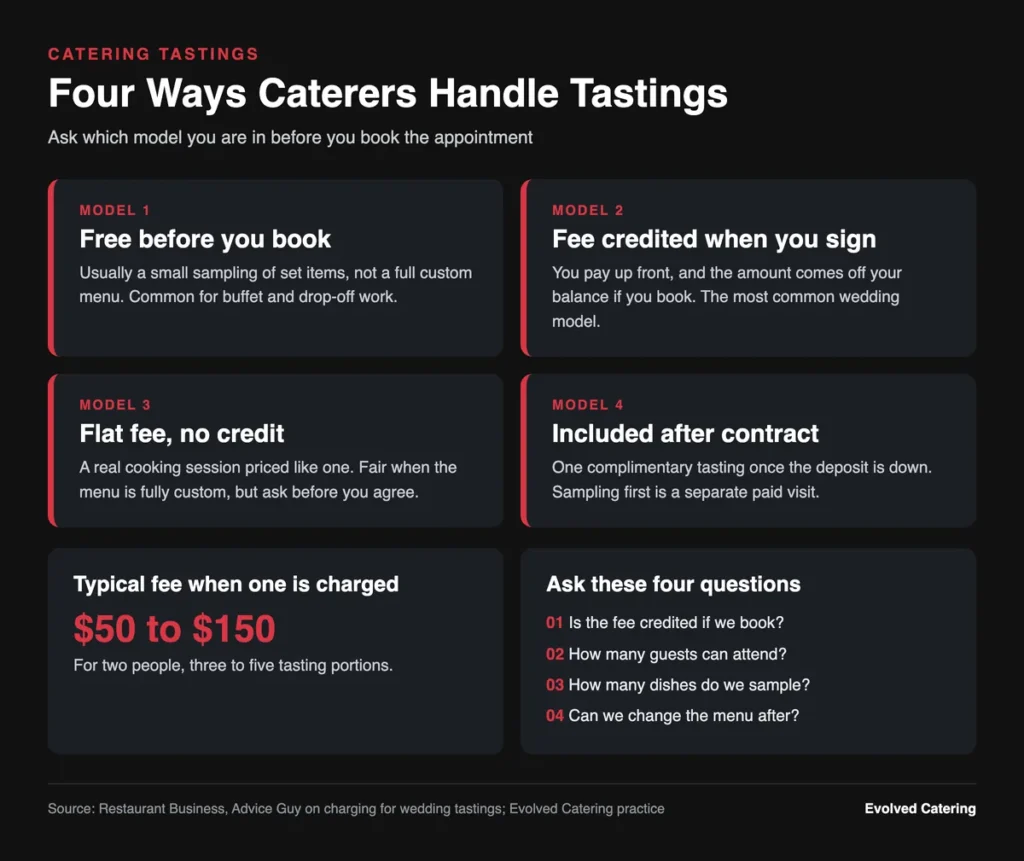
Many caterers do charge for a tasting, usually $50 to $150 for two people, and most of them credit that fee back if you book. Others hold tastings only after a deposit, and a few offer a small sampling for free before you commit.
There is no industry standard here. Restaurant Business has covered the debate among operators directly, and practice ranges from always free to a flat fee that never gets credited. Our full-service catering clients get their tasting policy in writing before anyone schedules a date.
Below are the four models you will run into, what a tasting actually costs a kitchen to produce, and the questions that keep you from paying twice.
The Four Tasting Models You Will Run Into
Almost every caterer runs one of four policies. Ask which one you are in during the first phone call, not after you arrive.
Free before you book
You sample a short list of set items with no charge. Common with buffet and drop-off work, where the menu is standardized and the kitchen is already producing those dishes. You will rarely get a custom menu at this stage.
Fee up front, credited when you sign
You pay for the tasting, then the amount comes off your balance if you book. This is the most common wedding model, and it is the fairest one for both sides. The caterer covers real costs, and the couple pays nothing extra in the end.
Flat fee, no credit
A paid cooking session priced like one. Reasonable when the menu is fully custom and the chef is developing dishes for you. Get it in writing, because this is the model people are most likely to misremember.
Included after the contract
One complimentary tasting once your deposit is down. If you want to sample before committing, that is a separate paid visit. Very common with high-volume caterers who cannot run tastings for every inquiry.
Why a Tasting Costs Money to Produce
A tasting is not leftovers on a plate. It is a small, unpaid catering job, and the costs land in four places.
Ingredients bought in single portions
A kitchen buys beef, seafood and produce in event volume. Cooking four portions means buying at retail-style scale with no efficiency at all, which is why premium proteins drive tasting fees up.
Chef labor outside service hours
Somebody has to prep, cook, plate and clean for a table of two. That is paid kitchen time on a day the chef could be executing a booked event.
Front-of-house time
A tasting usually comes with a sit-down about menus, timelines and logistics. That hour belongs to a sales or event manager, and it is not free either.
The no-show rate
Free tastings get booked by people who are still window shopping. A modest fee is the filter that keeps a kitchen from cooking for a table that never arrives, which is exactly why so many caterers moved to a credited fee.
How to Get the Most Out of a Tasting
Most people treat a tasting as a taste test. The couples and planners who get the most from it treat it as a rehearsal. The Knot found that 58 percent of couples call food and drink the most important part of their wedding, so a tasting is where the biggest piece of the guest experience gets decided.
Bring the people who actually decide, and keep the group small. Four opinions produce a menu. Eight opinions produce a stalemate, and most caterers cap the guest count anyway because every seat is another set of portions.
Ask to taste the dishes at the temperature your guests will get them. A protein that shines straight off the pass can read differently after twenty minutes in a chafer. Any honest kitchen will talk you through how a dish holds, and that conversation is worth more than the food itself.
Evolved Catering builds tastings around the menu we would actually execute at your venue, not a showcase version of it. Chef Zack Trabbold has taken Best Chef honors three years running and a third-place finish at the World Food Championship. None of that matters if a dish cannot survive a Baltimore loading dock and a fifteen-minute hold. So we plate it the way you will get it.
Take notes and photos on the day. Two months later, nobody remembers which sauce was on which plate, and a caterer would much rather work from your notes than from a vague memory.
Cost varies with your event type too. See per-guest wedding catering pricing for a full breakdown.
Questions to Ask Before You Book a Tasting
Five questions settle the whole thing, and all five can be asked in a single phone call.
Is there a fee, and is it credited if we book? How many people can attend? How many dishes will we sample, and can we pick them?
Do we taste before signing or after? And can the menu still change once the tasting is done, or is it locked from that point on?
That last question catches people out. Some contracts treat the tasting as the final menu approval, which means a change afterward triggers a revision fee. Ask now, not in month eight.
Timing matters too. Most tastings happen after a deposit, so the booking comes first and the menu gets built later. Our guide to how far in advance to book a caterer shows where a tasting fits into the wider planning calendar.
Finally, taste the format, not only the food. A dish that works plated may not work on a buffet line, and our breakdown of plated dinner versus buffet cost explains why the same menu behaves so differently in each service style.
Catering Tasting Questions
How much does a catering tasting usually cost?
When a fee is charged it commonly runs $50 to $150 for two guests, covering three to five tasting portions. Most caterers credit that amount toward your balance if you book, so the real cost is often zero once you sign.
Should I do a tasting before or after signing the contract?
It depends on the caterer’s policy, and both are normal. Sampling before signing helps you compare bids. Tasting after signing gets you a full custom menu because the kitchen already has your date. Ask which model applies before you schedule.
Do caterers offer tastings for corporate events or parties?
Less often, and usually only for large or recurring programs. Weddings get tastings because the menu is custom and the contract is large. For a Baltimore office lunch or a smaller party, ask about a sample platter instead. Call Evolved Catering at 443-400-7336 to talk it through.
Taste the Menu Before You Commit to It
Tell us your date, your venue and the dishes you are curious about. Evolved Catering will explain our tasting policy up front, in writing, so there is no confusion about what is charged, what is credited and what is included.